

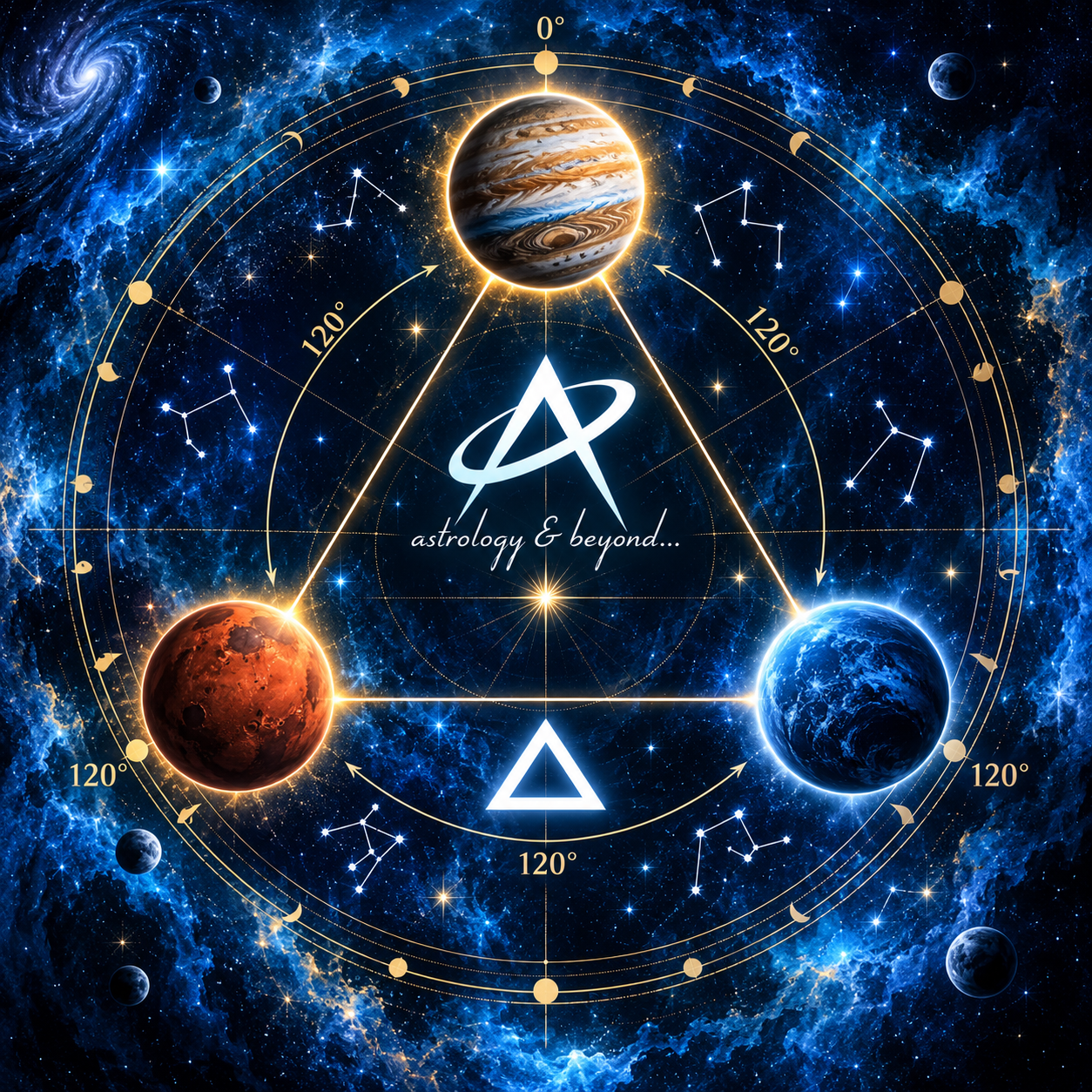
Trine
Overview
The Trine in Astrology – The Aspect of Harmony, Natural Flow, and Innate Potential
The trine is one of the major harmonious aspects in astrology. It occurs when two planets are positioned approximately 120° apart in the zodiac.
If, in a conjunction, planetary energies merge; in a sextile, an opportunity for cooperation emerges; and in a square, tension arises that requires action, then in a trine two planetary functions interact in a way that usually feels natural, fluid, and familiar.
One planet does not interfere with the other.
On the contrary, it seems to understand its language.
For this reason, one of the most appropriate keywords for the trine is:
Flow
However, the very ease of the trine also contains its particular challenge.
What comes naturally to us does not always compel us to develop it further.
What Is a Trine?
The zodiac contains 360°. When two planets are separated by approximately 120°, they form a trine.
Symbolically, we can represent it as:
Planet A △ Planet B
Three angles of 120° complete the entire circle:
3 × 120° = 360°
This creates the geometry of an equilateral triangle – one of the most stable and harmonious geometric structures.
This reflects the nature of the aspect very well.
In a trine, two planetary functions can interact without constantly having to overcome resistance from one another.
If the formula for the sextile was:
A ↔ B = an opportunity for cooperation
and for the square:
A ↔ B = tension that requires action
then for the trine we can say:
A ↔ B = natural cooperation and free-flowing energy
How Does the Trine Connect Planetary Energies?
Imagine two planets as two different abilities.
In a square, they speak different languages and must find a way to understand one another.
In a sextile, there is an opportunity for a productive exchange.
In a trine, they seem to already understand each other.
One planet says:
“What you do helps me express my own nature.”
And the other responds:
“And the way you function supports me as well.”
This creates a natural circulation of energy between them.
The trine is therefore associated with:
ease • harmony • talent • natural interaction • inner coherence
Why Is 120° Considered a Harmonious Aspect?
In traditional astrology, the trine is considered one of the most favorable aspects and is associated with the nature of Jupiter.
Jupiter symbolizes:
expansion • development • meaning • abundance • faith • growth
This corresponds well with the nature of the trine.
While the sextile is associated with Venus and the principle of attraction and cooperation, the trine describes an even more natural and unrestricted flow between two functions.
Three points separated by 120° create:
a triangle
and within the zodiac, the trine usually connects signs belonging to the same element.
This is one of the keys to understanding the aspect.
The Trine and the Four Elements
The trine naturally connects signs belonging to the same element.
Fire Trine
Aries – Leo – Sagittarius
The common principle is:
action • inspiration • vitality • confidence • self-expression
Earth Trine
Taurus – Virgo – Capricorn
The common principle is:
materialization • practicality • stability • form • realization
Air Trine
Gemini – Libra – Aquarius
The common principle is:
thinking • communication • ideas • social exchange • concepts
Water Trine
Cancer – Scorpio – Pisces
The common principle is:
emotion • sensitivity • intuition • psychological depth • connection
Because the signs share the same element, they have a common fundamental language.
For example:
Aries and Sagittarius are different signs, but both understand the principle of Fire.
Taurus and Capricorn function differently, but both operate through the Earth element.
The trine therefore creates:
different functions operating through a similar energetic principle.
The Trine as a Natural Talent
One of the most important characteristics of the trine is that it often represents abilities that a person experiences as natural.
They may be so natural that the individual does not even recognize them as talents.
This is an important idea.
When something has always come easily to you, you may assume:
“Everyone can do this.”
But that is not necessarily true.
A trine may indicate an area in which two psychological functions already know how to work together naturally.
Therefore, when interpreting a trine, we can ask:
“What comes so naturally to me that I may not recognize its value?”
The Trine Is Not a Guarantee of Success
This is extremely important.
A harmonious aspect should not automatically be turned into a promise.
For example:
Venus △ Jupiter
does not automatically mean:
“You will have lots of money, love, and good fortune.”
It indicates that the principles of:
Venus – values, relationships, pleasure
and:
Jupiter – growth, expansion, meaning
can work together relatively naturally.
But this potential must still be interpreted within the context of the entire horoscope.
The trine indicates:
ease of interaction
not:
a guaranteed life outcome.
The Paradox of the Trine
The square often forces a person to act.
The trine does not.
This is where the paradox of the trine lies.
The square says:
“You have to do something.”
The sextile says:
“You can do something.”
The trine says:
“This already works.”
And precisely because it already works, a person may feel no need to develop it further.
A strong trine can therefore represent:
a talent
but if it remains unconscious:
an unused talent.
Examples of Trines Between Planets
Sun △ Jupiter
The Sun represents:
identity • willpower • vitality • self-expression
Jupiter represents:
expansion • meaning • development • faith • perspective
With a trine between them, growth and self-expression can naturally support one another.
The person may feel:
“As I grow and expand my horizons, I become more fully myself.”
Jupiter gives the Sun space to expand.
The Sun gives Jupiter a personal direction.
Moon △ Venus
The Moon represents:
emotions • needs • security • habits
Venus represents:
relationships • attraction • pleasure • values
Here, emotional needs and the ability to connect with others can interact relatively naturally.
The inner question:
“What do I need?”
may be in harmony with:
“What do I value, and how do I connect?”
This can support emotional and social harmony.
Mercury △ Saturn
Mercury represents:
thinking • information • communication
Saturn represents:
structure • concentration • discipline • endurance
In the trine:
thought naturally finds structure.
This can support:
concentration • planning • organization • practical thinking
Saturn does not necessarily become an obstacle to Mercury.
Instead, it can provide Mercury with a framework.
Mercury △ Uranus
Mercury thinks.
Uranus discovers new possibilities.
The trine can create a natural flow between:
logic and originality
information and innovation
thought and insight
A person may find it relatively natural to see unconventional solutions or understand new concepts.
Venus △ Mars
Venus represents:
attraction • appreciation • connection
Mars represents:
desire • action • initiative
In a trine:
what I like and what I desire can easily find a common language.
Venus attracts.
Mars pursues.
There is a natural dynamic between them.
Venus △ Neptune
Venus represents:
beauty • values • relationships • aesthetics
Neptune represents:
imagination • ideals • sensitivity • inspiration
The trine can create a natural connection between:
beauty and imagination
and may support artistic, musical, symbolic, or creative perception.
However, once again, the aspect must be interpreted within the context of the entire horoscope.
Mars △ Saturn
This provides an interesting contrast with the square between the same planets.
With:
Mars □ Saturn
action and limitation may clash.
With:
Mars △ Saturn
action and structure can cooperate naturally.
Mars provides:
the energy.
Saturn provides:
the structure and endurance.
The result is:
disciplined action
This can be a powerful resource for sustained effort and long-term goals.
Jupiter △ Saturn
Jupiter expands.
Saturn structures.
At first glance, these principles may appear contradictory.
But in a trine, they can work together extremely constructively.
Jupiter says:
“Let us grow.”
Saturn responds:
“Let us build a foundation capable of supporting that growth.”
This creates the potential for:
structured expansion
or:
sustainable growth.
How Strong Is a Trine?
The exact trine occurs at:
120°00′
As with other aspects, astrologers use a certain orb around the exact angle.
The permitted orb depends on:
the astrological school • the planets involved • the type of chart • the methodology being used
For example:
120°15′
is an extremely tight trine.
While:
124°
may still be considered a trine depending on the system and the planets involved.
The general principle remains:
The closer the aspect is to exactly 120°, the more concentrated the relationship between the two functions.
Applying and Separating Trines
A trine can be:
Applying
or:
Separating
In an applying trine, the faster-moving planet is approaching the exact 120° aspect.
In a separating trine, the exact aspect has already occurred and the planets are moving away from one another.
This distinction is particularly important in:
traditional • horary • electional • predictive astrology
The Sign Shows How the Energy Flows
It is not enough simply to see:
Venus △ Jupiter
We must also examine the signs involved.
A trine between planets in Fire signs will function differently from a trine between planets in Water signs.
For example:
Fire Trine
may emphasize:
initiative • inspiration • confidence • action
While:
Water Trine
may emphasize:
sensitivity • emotional understanding • intuition • psychological connection
Interpretation therefore develops through several levels:
Planet
What function is involved?
Sign
How is that function expressed?
House
Where does it operate?
Aspect
How does it interact with the other function?
With a trine, we can add another important question:
“What already works naturally between them?”
The Houses Show Where the Natural Resource Exists
When two planets form a trine, their houses indicate two areas of life between which a natural connection may exist.
For example, a trine between planets in the:
2nd and 6th Houses
may connect:
resources • values • material stability
with:
work • daily routines • skills • practical functioning
A trine between the:
5th and 9th Houses
may connect:
creativity and self-expression
with:
knowledge • education • philosophy • expansion of horizons
The houses therefore show:
where the natural flow can become a practical resource in life.
The Trine in the Natal Chart
In the natal horoscope, the trine represents two psychological functions between which there is natural compatibility and coherence.
The individual often does not need to consciously “teach” these functions how to work together.
They already share a common language.
But this brings us back to the potential weakness of the trine:
the absence of necessity.
If something happens easily, a person may not invest enough effort in developing it.
Therefore, an important question when interpreting a natal trine is:
“Am I consciously using what comes naturally to me?”
The Trine in Transits
In transit work, the trine often indicates a period during which certain processes can unfold with less resistance.
Conditions may become more supportive of:
development
support
realization
easier solutions
the natural progression of a process
But, as with the sextile, we should not automatically expect a major external event.
Sometimes the trine simply indicates:
“The path is more open.”
But the individual still needs to walk along it.
The Trine in Synastry
In synastry, the trine can indicate areas where two people interact with natural ease and understanding.
For example:
Sun △ Moon
may create a natural connection between one person’s identity and the other person’s emotional nature.
Mercury △ Mercury
may facilitate communication, intellectual understanding, and the exchange of ideas.
Venus △ Mars
may create a natural flow between attraction and desire.
Jupiter △ Sun
may indicate a dynamic in which one person’s growth, optimism, or broader perspective supports the other’s self-expression.
However, a harmonious synastry aspect should never be interpreted in isolation.
A relationship is created by the entire interaction between the two charts, not by one trine.
The Trine in the Composite Chart
In a composite chart, the trine represents a natural resource within the relationship itself.
For example:
Mercury △ Saturn
may indicate that the relationship has a natural capacity for structured communication, planning, and practical problem-solving.
Venus △ Jupiter
may indicate an easy flow between affection, shared values, enjoyment, generosity, and development.
Mars △ Saturn
may support the relationship’s ability to act consistently and work toward long-term objectives.
The trine shows:
what the relationship may find relatively easy to do together.
How to Interpret a Trine
We can use the same practical method applied to the other aspects.
First, identify the function of each planet.
For example:
Mercury
“I think and communicate.”
Saturn
“I structure, stabilize, and take responsibility.”
Then ask:
How do these two functions naturally support each other?
With:
Mercury △ Saturn
we might formulate the dynamic as:
“My thinking naturally seeks structure, while structure helps me organize and express my thoughts.”
Another example:
Venus △ Mars
Venus:
“I attract, value, and connect.”
Mars:
“I desire, act, and pursue.”
The combination becomes:
“What I value and what I pursue can naturally support one another.”
This approach allows us to understand the underlying mechanism of the aspect rather than simply memorizing fixed interpretations.
Trine and Sextile – What Is the Difference?
Both are traditionally considered harmonious aspects, but they do not function in exactly the same way.
Sextile – 60°
Opportunity • Cooperation • Exchange • Development • Activation
The sextile creates a useful connection that often benefits from conscious activation.
Trine – 120°
Flow • Ease • Talent • Integration • Natural ability
The trine describes a connection that tends to operate more spontaneously.
We can summarize the distinction simply:
The sextile opens a door. The trine flows naturally.
The sextile says:
“Here is something you can develop.”
The trine says:
“Here is something that already knows how to work.”
Trine and Square – What Is the Difference?
These two aspects illustrate two very different developmental mechanisms.
Square – 90°
Tension • Challenge • Friction • Action • Development through effort
The square motivates because something does not work smoothly.
Trine – 120°
Harmony • Flow • Ease • Talent • Development through natural integration
The trine supports because the functions already cooperate.
We can summarize the difference as:
The square develops through resistance. The trine develops through flow.
But this leads to an important paradox:
The square may sometimes produce greater visible achievement because it creates pressure to act.
The trine may contain enormous talent that remains underdeveloped precisely because there is no pressure to use it.
The Essence of the Trine
The trine is fundamentally an aspect of natural harmony and integration.
Two planetary principles communicate without having to constantly overcome one another.
Their energies flow.
They support each other.
They understand each other’s language.
The simplest formula for the trine is:
Planet A + Planet B = natural cooperation and integrated potential
The more exact the trine, the more concentrated this connection may become.
The trine can indicate:
talent
but talent needs expression.
It can indicate:
ease
but ease needs direction.
It can indicate:
potential
but potential still needs to be lived.
This is why the deeper message of the trine is not simply:
“You are lucky.”
It is:
“Something within you already knows how to work – recognize it, develop it, and use it consciously.”
Find the Artistic side of ARIES
