

Cuincunx
Overview
The Quincunx in Astrology – The Aspect of Incompatibility, Adaptation, and Constant Readjustment
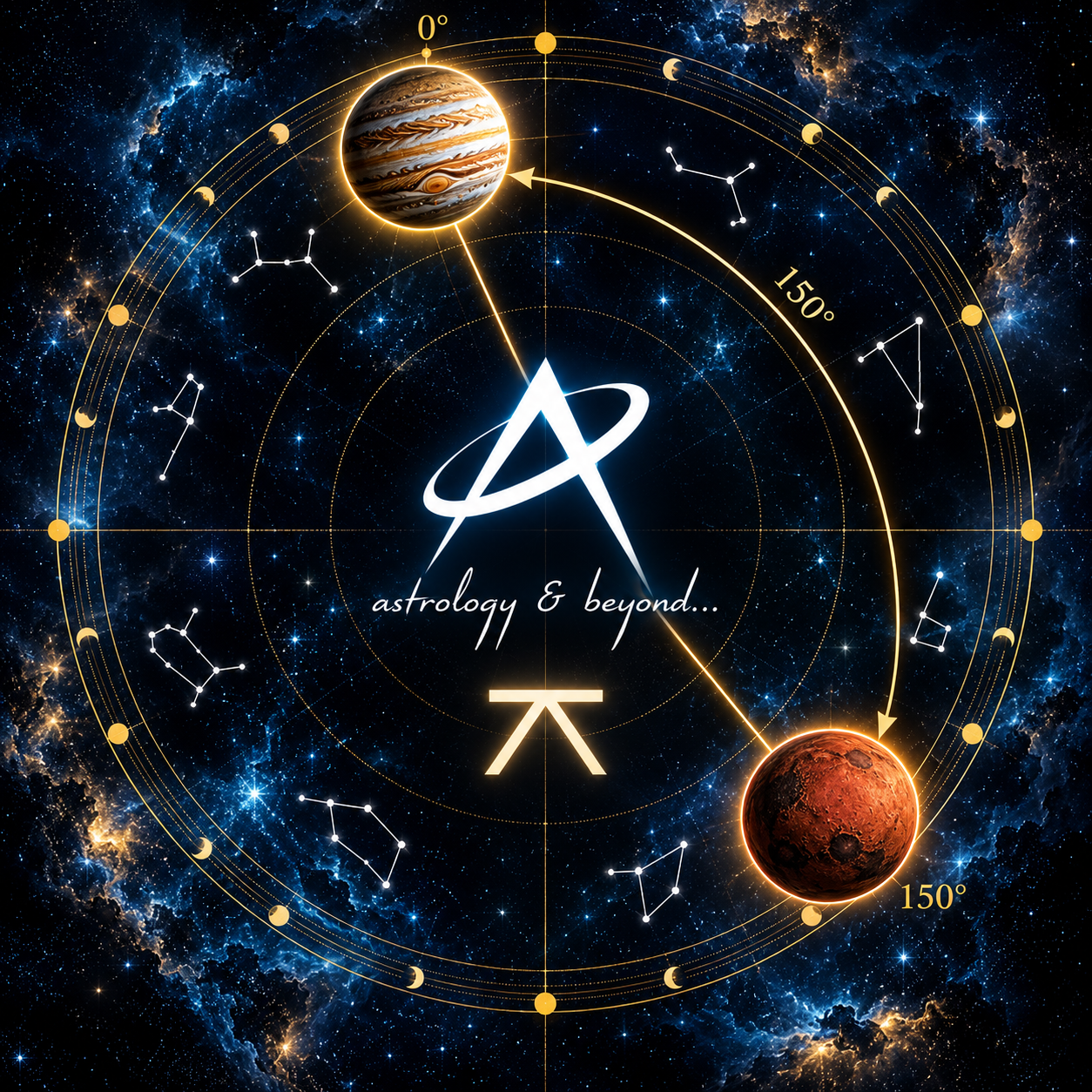
The quincunx is one of the most fascinating and frequently misunderstood aspects in astrology. It occurs when two planets are positioned approximately 150° apart in the zodiac.
It is also known as the inconjunct and is traditionally associated with two positions that have no natural relationship with one another.
If, in a conjunction, planetary energies merge; in a sextile, they cooperate; in a square, they clash; and in a trine, they flow naturally together, then in a quincunx two planetary functions seem to speak entirely different languages.
They are not in direct confrontation as they are in a square.
But neither can they easily cooperate.
For this reason, one of the most appropriate keywords for the quincunx is:
Adaptation
The aspect continually asks:
“How can I combine two functions that have no natural way of working together?”
What Is a Quincunx?
The zodiac contains 360°. When two planets are separated by approximately 150°, they form a quincunx.
Symbolically, the aspect is often represented as:
Planet A ⚻ Planet B
The quincunx lies between:
the trine – 120°
and:
the opposition – 180°.
However, its nature is not simply “something between a trine and an opposition.”
It has its own logic.
In a quincunx, the planets are usually positioned in signs that share neither of the two fundamental classifications:
element
nor:
modality.
This is one of the keys to understanding the aspect.
Why Do the Planets in a Quincunx Have Difficulty Understanding Each Other?
Consider two signs that form a quincunx:
Aries – Virgo
Aries is:
Fire + Cardinal
Virgo is:
Earth + Mutable
They share neither:
element
nor:
modality.
Another example:
Taurus – Sagittarius
Taurus is:
Earth + Fixed
Sagittarius is:
Fire + Mutable
Again, there is no shared element or modality.
This means that the two signs operate with different:
motivations • speeds • logic • strategies • ways of reacting
This lack of a common language lies at the heart of the quincunx.
How Does the Quincunx Connect Planetary Energies?
Imagine two planets that must function within the same system but have received completely different instructions.
One says:
“For me, this is the correct way to operate.”
The other responds:
“But that does not solve my problem at all.”
In a square, the conflict is often obvious.
We know where the tension lies.
With the quincunx, the situation can be more elusive.
A person may feel that:
something does not quite fit
without always knowing exactly what needs to change.
This is why the quincunx requires:
adjustment • adaptation • calibration • compromise • reorganization
The Quincunx Does Not Seek a Final Solution
This is one of the most important characteristics of the aspect.
With a square, we often look for a way to integrate two functions through action.
With a quincunx, there may not be one final solution that permanently removes the tension.
Instead, there is often a process of:
constant readjustment.
Imagine two mechanisms operating at different speeds.
You cannot simply connect them and expect the system to function automatically.
You need to periodically adjust one in relation to the other.
This is the essence of the quincunx:
Not a final solution, but continuous adjustment.
The Quincunx as an Aspect of Incompatibility
The word “incompatibility” does not mean that the two planets can never function together.
It means that there is no automatic compatibility between them.
In a trine, the planets say:
“I understand you.”
In a sextile:
“We can help each other.”
In a square:
“What you are doing interferes with me.”
In a quincunx:
“I do not understand why you operate that way at all.”
This difference gives the aspect its distinctive character.
The Quincunx and the Need for Adaptation
When two functions cannot naturally synchronize, the individual must develop the ability to modify the way they are used.
This may mean:
sometimes prioritizing one function;
sometimes prioritizing the other;
sometimes changing the strategy;
sometimes accepting that a perfect balance does not exist.
The quincunx can therefore develop a very important ability:
flexibility.
Not flexibility in the purely mutable-sign sense, but the ability to recognize when a system needs correction.
Examples of Quincunxes Between Planets
Sun ⚻ Moon
The Sun represents:
identity • willpower • conscious direction • self-expression
The Moon represents:
emotions • needs • security • instinctive reactions
With a quincunx, there may be a sense that:
what a person consciously wants does not always correspond to what they emotionally need.
The Sun says:
“I want to move in this direction.”
The Moon responds:
“But I do not feel secure there.”
The task is not necessarily for one side to defeat the other.
Instead, there must be periodic readjustment between:
“Who do I want to be?”
and:
“What do I need?”
Mercury ⚻ Saturn
Mercury represents:
thinking • information • communication • adaptability
Saturn represents:
structure • boundaries • discipline • control
With a quincunx, the way a person thinks and communicates may not easily correspond to their need for structure.
Mercury may say:
“Let us consider another possibility.”
Saturn may respond:
“We need to make a final decision.”
The task is to continually adjust the relationship between:
flexibility and structure
information and decision
communication and control
Venus ⚻ Mars
Venus represents:
attraction • values • relationships • pleasure
Mars represents:
desire • action • initiative • sexual drive
In a conjunction, these functions merge.
In a trine, they interact naturally.
But in a quincunx:
what a person likes and the way they pursue what they want may not be fully synchronized.
Venus says:
“I am attracted to this.”
Mars responds:
“But that is not how I act.”
This may require adjustment between:
attraction and action
closeness and desire
values and impulse
Mars ⚻ Saturn
Mars represents:
action • impulse • desire • movement
Saturn represents:
structure • limitation • control • time
In a square, the conflict can be very direct:
“Act!” versus “Stop!”
In a quincunx, the interaction may be more complex.
The questions may become:
When should I act?
How much effort should I invest?
When should I accelerate and when should I slow down?
This requires constant calibration between:
energy and limitation.
Jupiter ⚻ Saturn
Jupiter represents:
expansion • growth • perspective • opportunity
Saturn represents:
limitation • structure • reality • sustainability
Jupiter says:
“Let us expand.”
Saturn asks:
“Can we afford to?”
In a trine, growth and structure can naturally support each other.
In a square, they may clash.
In a quincunx, the problem is different:
the scale of growth must continually be readjusted according to real limitations.
This becomes a process of ongoing calibration.
Moon ⚻ Uranus
The Moon seeks:
emotional security • predictability • belonging
Uranus seeks:
freedom • change • individuality • liberation
Here, the individual may repeatedly encounter the question:
“How can I have security without losing my freedom?”
If too much priority is given to the Moon, Uranus may feel restricted.
If Uranus receives complete freedom, the Moon may lose its sense of stability.
The system therefore requires:
constant adaptation between security and freedom.
The Quincunx and Health
In some traditional and modern astrological schools, the quincunx has been associated with themes such as:
adaptation • imbalance • daily habits • health • the need for adjustment
It is important to be careful here.
The presence of a quincunx does not automatically indicate illness and should never be used as a medical diagnosis.
It is more useful to understand the aspect symbolically as an indication of areas where the system may require:
finer regulation, observation, and adjustment.
How Strong Is a Quincunx?
The exact quincunx occurs at:
150°00′
A tighter orb is generally used for the quincunx than for major aspects such as the conjunction, square, trine, and opposition.
Different astrological schools use different values.
For example:
150°20′
is a very tight quincunx.
The farther the aspect moves away from exactly 150°, the more carefully we should consider whether there is sufficient reason to give it significant interpretative weight.
Accuracy is particularly important when working with minor aspects.
Applying and Separating Quincunxes
A quincunx can be:
Applying
or:
Separating
In an applying quincunx, the faster-moving planet is approaching the exact 150° aspect.
In a separating quincunx, the exact aspect has already occurred and the planets are moving away from one another.
This distinction can be particularly useful in dynamic and predictive astrology.
The Sign Is Especially Important in a Quincunx
With this aspect, the signs are particularly important because their lack of similarity explains much of the difficulty in coordination.
For example:
Aries ⚻ Virgo
Aries asks:
“What can I do right now?”
Virgo asks:
“How can I do it correctly?”
Both strategies can be useful.
But they operate at different speeds and according to different logic.
Or consider:
Leo ⚻ Pisces
Leo seeks:
clear self-expression and a strong individual center.
Pisces seeks:
dissolution, sensitivity, and connection with something larger.
The task is not to declare one strategy correct and the other wrong.
The task is to understand:
when one is needed and when the other is needed.
The Houses Show Where Adaptation Is Required
In a quincunx, the houses can indicate two areas of life that do not coordinate automatically.
For example, planets in the:
1st and 6th Houses
may raise questions concerning:
personal identity
and:
work, daily responsibilities, habits, and routines.
The individual may periodically need to change their daily routine so that it better reflects their personal needs.
Or, conversely, they may need to adapt personal desires to practical requirements.
A quincunx between the:
2nd and 7th Houses
may require adjustment between:
personal values and resources
and:
partnerships and relationships.
The houses therefore show:
where the system needs to be calibrated.
The Quincunx in the Natal Chart
In the natal horoscope, the quincunx represents two psychological functions that do not have an automatic way of cooperating.
The individual may periodically experience:
discomfort
misalignment
the need for change
a sense that something needs to be corrected
But through repeated adjustments, the person can develop:
a refined capacity for adaptation.
The quincunx should therefore not be viewed simply as a weak or unpleasant aspect.
It can develop an extremely important ability:
the ability to recognize when an existing approach no longer works and needs to be modified.
The Quincunx in Transits
In transit work, the quincunx can indicate a period of:
readjustment • correction • adaptation • changing habits • reorganization
There may not necessarily be a major external conflict.
Instead, the person may feel:
“Something no longer fits quite right.”
It may become necessary to:
adjust a schedule;
change a strategy;
redistribute resources;
modify expectations;
change the way one responds to a situation.
The key question is:
“What needs to be readjusted?”
The Quincunx in Synastry
In synastry, a quincunx may indicate two planetary functions between partners that do not automatically understand one another.
For example:
Venus ⚻ Mars
may show differences between the way one person expresses attraction and the way the other expresses desire and initiative.
Moon ⚻ Mercury
may indicate that:
one person’s emotional language
and:
the other person’s way of thinking and communicating
do not translate easily into one another.
This does not necessarily mean:
“Incompatibility.”
It means something closer to:
“Translation is required here.”
And sometimes that translation needs to happen repeatedly.
The Quincunx in the Composite Chart
In a composite chart, the quincunx can represent two functions within the relationship that require ongoing adjustment.
For example:
Venus ⚻ Saturn
may indicate that the relationship repeatedly needs to recalibrate the balance between:
closeness • affection • pleasure
and:
responsibility • boundaries • commitment • structure
With:
Mars ⚻ Uranus
the relationship may need to continually adjust between:
shared action and direction
and:
freedom, independence, and change.
The quincunx does not necessarily indicate that the relationship cannot work.
It indicates that:
this area is unlikely to remain permanently “solved.”
It may require periodic recalibration as circumstances change.
How to Interpret a Quincunx
We can use the same practical method applied to the other aspects.
First, identify the basic function of each planet.
For example:
Moon
“I feel, respond instinctively, and seek security.”
Uranus
“I seek freedom, change, and individuality.”
Then ask:
Why do these two functions have difficulty understanding each other?
With:
Moon ⚻ Uranus
we might formulate the dynamic as:
“My need for emotional security does not always fit naturally with my need for freedom and change.”
The next question is the key to the quincunx:
“What needs to be adjusted right now?”
Not:
“How can I solve this forever?”
but:
“What adjustment does the present situation require?”
This distinction captures the deeper mechanism of the aspect.
Quincunx and Square – What Is the Difference?
Both aspects can create difficulty, but they do so in different ways.
Square – 90°
Tension • Friction • Conflict • Action • Development through effort
The problem is often relatively clear.
Two functions directly interfere with one another.
Quincunx – 150°
Misalignment • Adaptation • Adjustment • Calibration • Reorganization
The problem may be less obvious.
The functions do not necessarily attack one another.
They simply do not naturally fit together.
We can summarize the difference as:
The square demands action. The quincunx demands adjustment.
Quincunx and Opposition – What Is the Difference?
The opposition creates two clear poles.
Opposition – 180°
“I see the other side.”
The challenge involves awareness, polarity, projection, and balance.
The quincunx is different.
Quincunx – 150°
“I cannot easily understand how these two things belong in the same system.”
The opposition seeks:
balance between two poles.
The quincunx seeks:
functional adjustment between two different systems.
Quincunx and Sextile – What Is the Difference?
This comparison is especially interesting because the angles differ by 90°:
Sextile – 60°
The functions have an opportunity to cooperate.
Quincunx – 150°
The functions require adjustment in order to cooperate.
The sextile says:
“We can help each other.”
The quincunx says:
“We need to change something before we can work together effectively.”
The Quincunx and the Yod
The quincunx becomes especially significant when it participates in an aspect configuration known as the:
Yod
A Yod is formed when two planets are in sextile to one another and both form quincunxes to a third planet.
Geometrically, we have:
60° + 150° + 150°
The third planet becomes the apex of the configuration.
Symbolically, this creates an interesting structure:
Two planets have a constructive relationship through the sextile, but their combined energy requires repeated adjustment through the apex planet.
This makes the Yod a configuration strongly associated with:
adaptation • redirection • repeated adjustment • concentration on the apex function
It should not automatically be interpreted as “fate” or as evidence that someone has a special destiny.
Its significance depends on:
the planets involved • the signs • the houses • the exactness of the aspects • the entire horoscope
The Essence of the Quincunx
The quincunx is fundamentally an aspect of misalignment and adaptation.
Two planetary functions need to exist within the same system, but they do not share an obvious common language.
They cannot simply merge.
They do not naturally flow together.
They may not even openly confront each other.
Instead, they require:
continuous calibration.
The simplest formula for the quincunx is:
Planet A + Planet B = a relationship that requires ongoing adjustment
The quincunx can create:
discomfort
but also:
adaptability.
It can create:
misalignment
but also:
greater awareness of subtle imbalances.
It can create:
the need for repeated correction
but through that process develop:
flexibility and precision.
The deeper message of the quincunx is therefore:
“Not everything can be perfectly resolved – some things must be continually adjusted.”
Find the Artistic side of ARIES
