

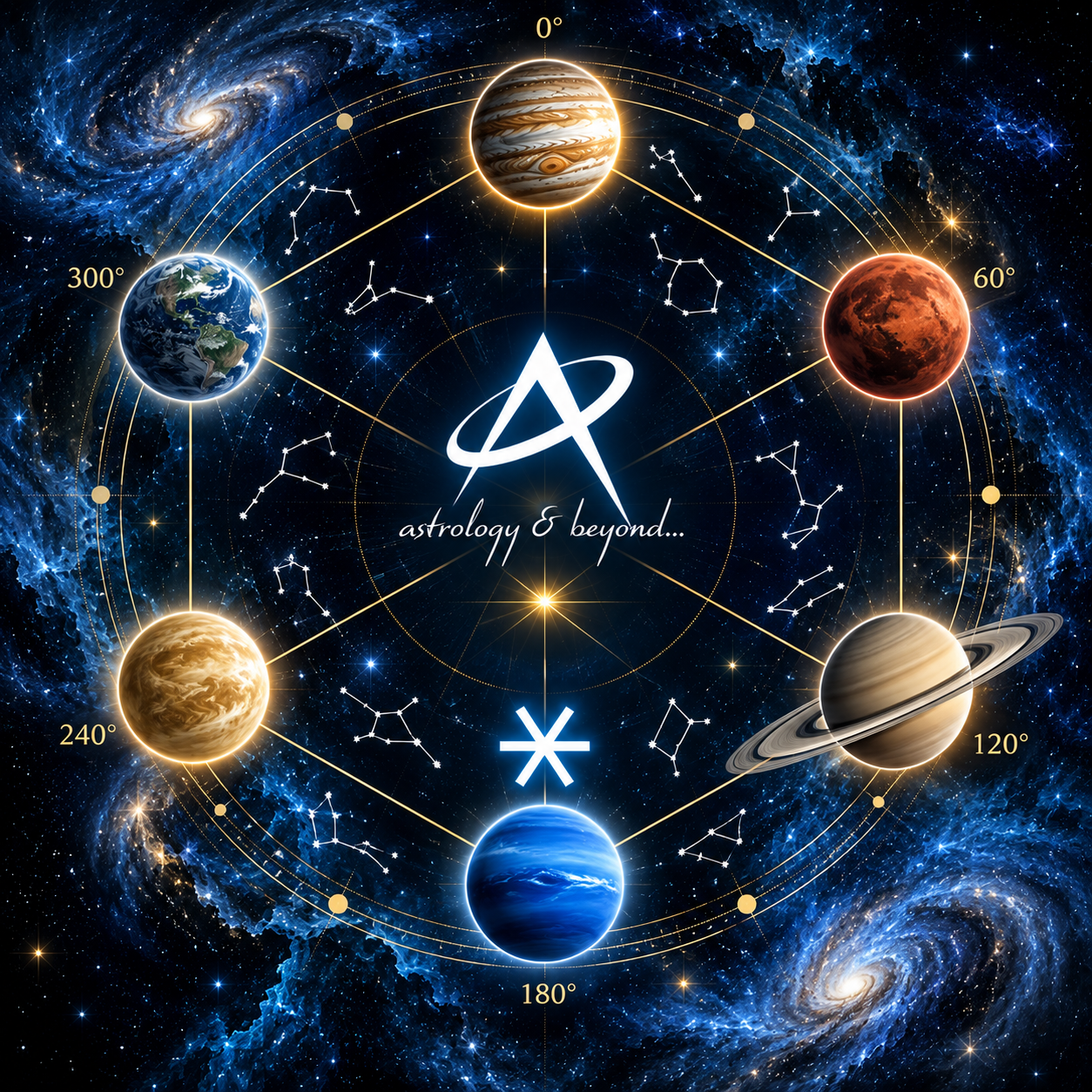
Sextile
Overview
The Sextile in Astrology – The Aspect of Opportunity, Cooperation, and Development
The sextile is one of the major harmonious aspects in astrology. It occurs when two planets are positioned approximately 60° apart in the zodiac.
If, in a conjunction, two planetary energies merge and operate as a single complex, in a sextile they retain their individuality while gaining the opportunity to cooperate with one another.
This is an important distinction.
A sextile does not simply mean “something good.” It indicates the potential for constructive exchange between two different planetary functions. One planet may provide the other with a resource, idea, opportunity, or pathway for development.
For this reason, one of the most appropriate keywords for the sextile is:
Opportunity
However, this opportunity usually needs to be recognized and consciously used.
What Is a Sextile?
The zodiac consists of 360°. When two planets are separated by approximately 60°, they form a sextile.
Symbolically, we can represent it as:
Planet A ✶ Planet B
Unlike the conjunction, where the planets occupy essentially the same position, the sextile contains distance between them.
That distance matters.
The planets do not merge.
They communicate.
Each planet retains its own function, but a channel exists between them through which their qualities can interact constructively.
If the formula for the conjunction was:
A + B = one combined complex
then for the sextile we can use:
A ↔ B = an opportunity for cooperation
Why Is 60° Considered a Harmonious Aspect?
In traditional astrology, the sextile belongs to the favorable aspects and is associated with the principle of Venus.
This is significant because Venus symbolizes connection, attraction, agreement, and the ability to bring different things into a harmonious relationship.
Geometrically, six sextiles of 60° divide the entire zodiac:
6 × 60° = 360°
This produces the structure of a hexagon and, when certain points are connected, a six-pointed star.
Within the zodiac, the sextile often connects signs belonging to compatible elements:
Fire ↔ Air
or
Earth ↔ Water
This creates a natural possibility for interaction.
Fire receives movement and ideas from Air, while Air receives direction and motivation from Fire.
Earth can give form and stability to Water, while Water can bring sensitivity and emotional depth to Earth.
The structure of the zodiac itself therefore illustrates one of the central principles of the sextile:
Different qualities that can be useful to one another.
How Does the Sextile Connect Planetary Energies?
Imagine two planets as two different abilities.
In a challenging aspect, they may confront each other with a problem.
In a conjunction, they merge.
In a sextile, one planet seems to say to the other:
“I have something you can use.”
This makes the sextile an aspect of resource exchange.
For example:
Mercury ✶ Jupiter
Mercury represents thinking, information, and communication.
Jupiter represents expansion, knowledge, meaning, and a broader perspective.
In a sextile:
thinking gains perspective, while the larger idea gains a language through which it can be expressed.
A person may find it relatively easy to connect specific information with broader concepts.
However, the aspect does not automatically mean that the person will become a teacher, writer, or philosopher.
It indicates that a constructive potential for cooperation exists between these two functions.
The Sextile as an Aspect of Opportunity
This is one of the most important characteristics of the sextile.
The trine is often experienced as a quality that flows relatively naturally. The sextile is also harmonious, but it usually contains more dynamism and potential for conscious activation.
We can express the difference symbolically:
The trine says:
“This comes naturally to me.”
The sextile says:
“There is something here that I can develop.”
This is precisely why sextiles can be extremely productive.
They do not eliminate the need for action.
On the contrary, their potential is often expressed most effectively when a person actively uses the connection between the two planets.
Examples of Sextiles Between Planets
Sun ✶ Jupiter
The Sun represents identity, willpower, vitality, and self-expression.
Jupiter represents growth, meaning, knowledge, faith, and the expansion of one’s horizons.
This sextile may provide opportunities for personal development through:
knowledge • education • travel • philosophy • broader perspectives
A possible formula is:
“By expanding my horizons, I develop myself.”
Moon ✶ Venus
The Moon is associated with emotional needs, instinctive reactions, habits, and the need for security.
Venus represents attraction, relationships, pleasure, values, and connection.
A sextile between them can create an opportunity:
to harmonize emotional needs with relationships and affection.
The individual may find constructive ways to express care, affection, and emotional warmth and to create a pleasant emotional environment.
Mercury ✶ Mars
Mercury thinks.
Mars acts.
In the sextile:
thought can support action, while action can stimulate thought.
This can be useful for decision-making, argumentation, initiative in communication, or transforming an idea into concrete action.
Venus ✶ Saturn
Venus seeks connection and value.
Saturn seeks stability, structure, responsibility, and durability.
A sextile between them may provide potential for:
stability in relationships • loyalty • building value over time • a practical approach to resources
Saturn can give structure and durability to what Venus values.
Mars ✶ Jupiter
Mars represents action.
Jupiter represents expansion.
Together they create the possibility of:
action that leads to growth.
Mars provides the impulse.
Jupiter provides the broader goal.
When used constructively, initiative can be supported by confidence, perspective, and a desire for development.
Mercury ✶ Uranus
Here, ordinary thinking interacts with the principle of innovation and change.
Mercury provides the language.
Uranus provides the breakthrough.
This can create opportunities for:
original thinking • innovative solutions • interest in technology • rapid understanding of new concepts
Venus ✶ Neptune
Venus represents beauty, values, attraction, and relationships.
Neptune represents imagination, ideals, sensitivity, and inspiration.
The sextile can create a productive connection between:
aesthetics and imagination
and may find expression through art, music, creativity, romantic sensitivity, or an enhanced appreciation of subtle emotional and aesthetic qualities.
However, the rest of the chart must show how this potential is actually expressed.
A Sextile Is Not a Guarantee
One of the most common mistakes when interpreting harmonious aspects is turning them into promises.
For example:
Venus ✶ Jupiter
does not automatically mean:
“You will be lucky in love and money.”
A more accurate interpretation would be:
There is a constructive channel between the principles of Venus and Jupiter.
Values, relationships, pleasure, and attraction can interact productively with growth, optimism, meaning, and expansion.
But how a person uses this opportunity depends on the entire chart.
An astrological aspect describes a structure of interaction, not a guaranteed life event.
How Strong Is a Sextile?
The exact sextile occurs at:
60°00′
As with other aspects, astrologers use an orb around the exact angle.
Different astrological schools use different orbs, and the appropriate orb may also depend on the planets involved.
Generally, the sextile is interpreted with a smaller orb than the conjunction or opposition.
For example:
60°20′ – a very tight sextile.
62° – may still be considered a sextile in many systems.
The closer the aspect is to exactly 60°, the more clearly the interaction between the two planets will usually be expressed.
Applying and Separating Sextiles
As with the conjunction, we can distinguish between an:
Applying sextile
and a:
Separating sextile
In an applying sextile, the faster-moving planet is approaching the exact 60° aspect.
In a separating sextile, the exact aspect has already occurred and the planets are moving away from it.
This distinction is particularly important in traditional, horary, and predictive astrology.
The Sign Changes the Way the Sextile Works
It is not enough simply to observe:
Mars ✶ Jupiter
We also need to know where Mars and Jupiter are located.
Mars in a Fire sign may express itself very differently from Mars in an Earth or Water sign.
A complete interpretation therefore develops on several levels:
Planet
What function is involved?
Sign
How is that function expressed?
House
In which area of life does it operate?
Aspect
How does it interact with the other planet?
The sextile then stops being an isolated interpretation and becomes part of the overall structure of the horoscope.
The Houses Show Where the Opportunity Exists
When two planets form a sextile, their houses indicate the areas of life between which a productive connection can potentially be developed.
For example, a planet in the 2nd house sextile a planet in the 4th house may connect:
resources and personal values
with:
home, family, roots, and inner security.
Planets in the 5th and 7th houses may connect:
creativity and personal self-expression
with:
partnerships and relationships.
The sextile can therefore also be understood as a bridge between two areas of life.
The Sextile in the Natal Chart
In a natal chart, the sextile indicates an inherent opportunity for cooperation between two psychological functions.
It is often a quality that can be developed over time.
Sextiles may sometimes be less immediately noticeable than squares and oppositions.
The reason is simple:
Tension demands attention.
Opportunity does not always demand it.
A person may have an excellent sextile in the natal chart, but if they never place themselves in situations that activate its potential, the aspect may remain relatively passive.
This is one of the essential characteristics of the sextile:
It provides a possibility, but the individual participates in its development.
The Sextile in Transits
In transit work, the sextile often indicates a period during which an opportunity for constructive development becomes available.
This may appear as:
a new idea;
a useful contact;
an offer;
an educational opportunity;
an important conversation;
a possibility for change;
or circumstances that facilitate development.
Again, however, the key word is:
Opportunity
A transiting sextile does not necessarily create an event by itself.
Very often, it opens a door.
The question is whether the individual chooses to walk through it.
The Sextile in Synastry
In synastry, a sextile between two planets can indicate areas in which two people may relatively easily support, stimulate, or complement one another.
For example:
Mercury ✶ Mercury
may facilitate communication and the exchange of ideas.
Venus ✶ Mars
may create a constructive interaction between attraction and initiative.
Sun ✶ Jupiter
may indicate opportunities for one person to encourage the other’s confidence, growth, or development.
However, no single aspect in synastry should be interpreted in isolation.
The overall interaction between the two charts remains essential.
The Sextile in the Composite Chart
In a composite chart, the sextile represents a resource that the relationship itself can potentially use.
For example:
Mercury ✶ Saturn
may give the relationship the potential to develop structured communication, planning, and practical problem-solving.
With:
Venus ✶ Jupiter
the relationship may contain opportunities for development through shared values, enjoyment, social interaction, generosity, or the expansion of a shared perspective.
Once again, the key principle is:
The potential needs to be used.
How to Interpret a Sextile
A practical method is to begin by identifying the basic function of each planet.
For example:
Mercury
“I think and communicate.”
Jupiter
“I expand and search for meaning.”
Then ask:
How can one function help the other?
This gives us:
Mercury ✶ Jupiter
“My thinking opens new horizons, while a broader perspective develops the way I think.”
Another example:
Venus ✶ Saturn
Venus:
“I connect and determine what I value.”
Saturn:
“I structure, stabilize, and take responsibility.”
The combination becomes:
“I can give stability and structure to what I value.”
This method allows us to understand the aspect rather than simply memorize fixed interpretations.
Sextile and Trine – What Is the Difference?
Both aspects are traditionally considered harmonious, but they are not identical.
Sextile – 60°
Opportunity • Cooperation • Exchange • Development • Activation
The sextile connects two planetary functions that can work well together, especially when the individual consciously activates their relationship.
Trine – 120°
Flow • Natural ability • Ease • Integration • Familiarity
The trine tends to describe a more spontaneous and effortless connection between planetary principles.
We can summarize the distinction simply:
The trine flows. The sextile opens a door.
The trine often shows what comes naturally.
The sextile often shows what can become a resource when we choose to develop it.
The Essence of the Sextile
The sextile is an aspect of possibility, communication, and constructive cooperation.
The planets do not merge as they do in a conjunction.
They do not confront one another as they may in a square or opposition.
Instead, they establish a relationship in which each planet can provide something useful to the other.
The simplest formula for the sextile is:
Planet A + Planet B = an opportunity for constructive cooperation
The more exact the sextile, the more clearly this channel between the two functions may be expressed.
But the sextile carries an important message:
Potential is not the same as realization.
It gives us an opening.
It provides a resource.
It creates a connection.
What we do with that connection determines how fully the aspect becomes part of our lived experience.
Find the Artistic side of ARIES
