

Square
Overview
The Square in Astrology – The Aspect of Tension, Action, and Development
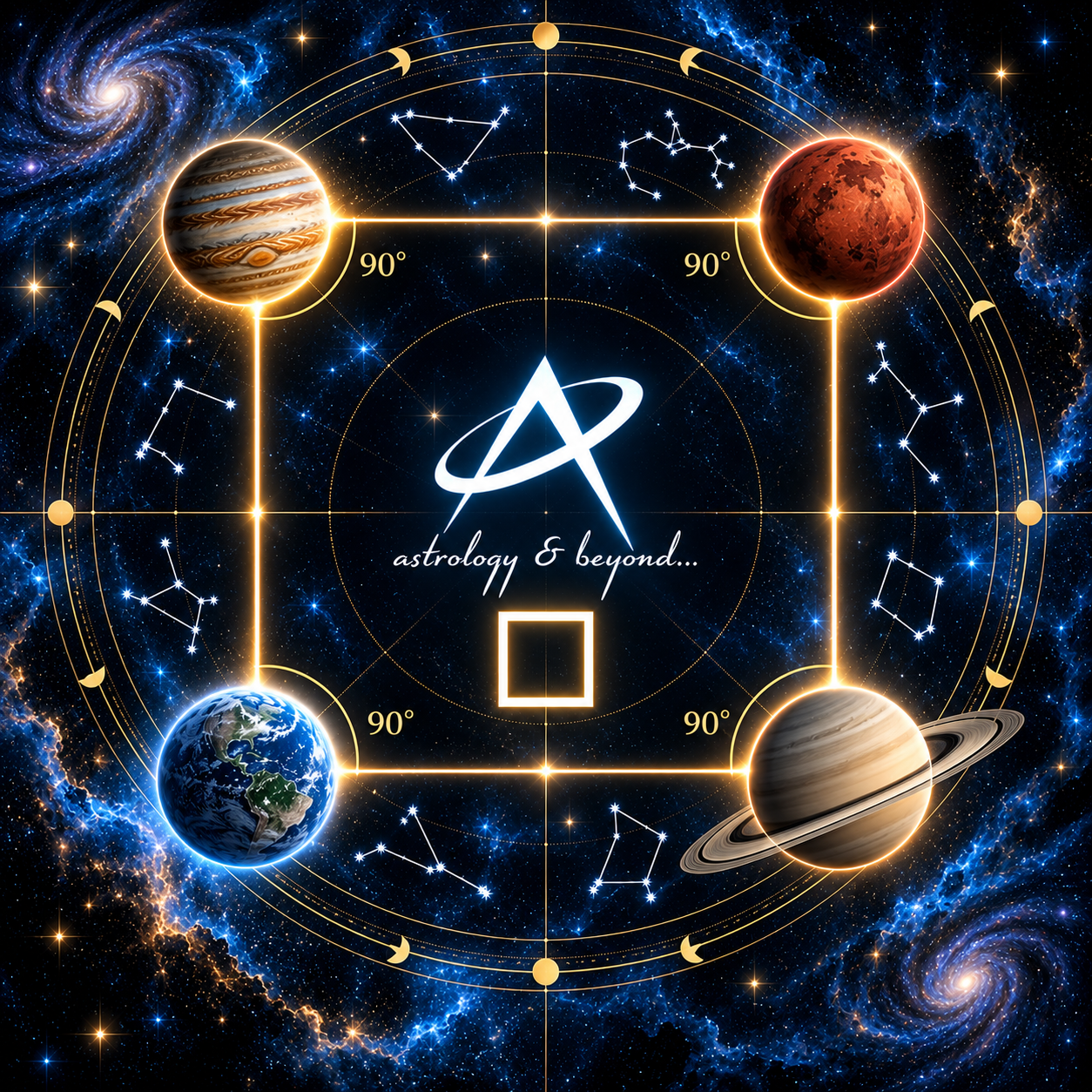
he square is one of the major dynamic aspects in astrology. It occurs when two planets are positioned approximately 90° apart in the zodiac.
If, in a conjunction, planetary energies merge, and in a sextile they are given an opportunity for constructive cooperation, in a square two different planetary functions meet in a way that creates tension and a need for action.
The planets cannot simply ignore one another.
Each insists on expressing its own nature, yet the way one planet functions may interfere with the immediate expression of the other.
For this reason, one of the most appropriate keywords for the square is:
Challenge
But challenge should not automatically be understood as something negative.
The square can be one of the most powerful driving forces for development, action, achievement, and change in the horoscope.
What Is a Square?
The zodiac contains 360°. When two planets are separated by approximately 90°, they form a square.
Symbolically, we can represent it as:
Planet A □ Planet B
Four angles of 90° complete the entire circle:
4 × 90° = 360°
This creates the geometry of the square – a stable structure, but also one in which forces operate from different directions.
This describes the nature of the aspect very well.
In a square, we have two functions that must find a way to exist and operate simultaneously, even though their immediate needs may be different.
If the formula for the sextile was:
A ↔ B = an opportunity for cooperation
then for the square we can say:
A ↔ B = tension that requires action
How Does the Square Connect Planetary Energies?
Imagine two forces pulling a system in different directions.
One planet says:
“I need to function this way.”
The other responds:
“But my needs require something different.”
Neither planet disappears.
Neither can simply be switched off.
This creates internal or external tension.
And it is precisely this tension that creates the need to search for:
solutions • action • adaptation • strategy • development
This is why the square is considered a dynamic aspect.
It creates movement.
The Square Does Not Mean a “Bad Aspect”
One of the most common mistakes in popular astrology is dividing aspects into:
good
and
bad.
Trines and sextiles are labeled “good,” while squares and oppositions are labeled “bad.”
This is an oversimplification.
The square can certainly indicate conflict, frustration, obstacles, or pressure, but the same tension can become a source of:
motivation • ambition • resilience • achievement • change • development
Very often, the areas in which a person experiences inner tension are precisely the areas they work on most intensely.
Therefore, the square does not say:
“You will inevitably fail here.”
It says something closer to:
“You will find it difficult to remain completely passive here.”
The Square as a Driving Force
Imagine a person experiencing no inner tension at all.
There is no problem.
There is no dissatisfaction.
There is no reason for anything to change.
Why would they act?
The square creates a difference between:
what is
and
what needs to be done.
That difference can generate motivation.
This is why squares can often be prominent in the charts of people who demonstrate considerable ambition or persistence.
Not because a square automatically produces success.
Rather, because it can create a need to work on a particular problem repeatedly until a more effective way of dealing with it is developed.
The Square and the Modalities
Within the zodiac, the square usually connects signs belonging to the same modality:
Cardinal Signs
Aries • Cancer • Libra • Capricorn
Fixed Signs
Taurus • Leo • Scorpio • Aquarius
Mutable Signs
Gemini • Virgo • Sagittarius • Pisces
This is very important for understanding the nature of the square.
The signs may share a similar mode of action while pursuing very different objectives because they belong to different elements.
For example:
Aries □ Cancer
Both signs are cardinal.
Both want to initiate.
But Aries initiates through direct action and individual impulse, while Cancer acts through emotional security, belonging, protection, and preservation.
Therefore, the conflict is not necessarily between:
action and inaction.
Rather, it is between:
two different ways of initiating and directing action.
Examples of Squares Between Planets
Sun □ Saturn
The Sun represents:
identity • willpower • vitality • self-expression
Saturn represents:
boundaries • structure • responsibility • control • time
The Sun says:
“I want to be myself and express who I am.”
Saturn says:
“First prove yourself, build something, create structure, and take responsibility.”
This can create an experience of restriction or high expectations placed upon oneself.
But the same configuration can gradually develop:
self-discipline • resilience • seriousness • the ability to build something over the long term
The challenge and the potential emerge from the same planetary combination.
Moon □ Mars
The Moon represents:
emotions • security • instincts • habits
Mars represents:
action • desire • impulse • assertion
Here, emotional reactions and the impulse to act can easily activate one another.
A person may:
act because they are emotionally affected
or:
experience strong emotions as a consequence of their actions.
The task is to find a constructive way of connecting:
I feel ↔ I act
without one function constantly provoking the other.
Mercury □ Neptune
Mercury is associated with:
logic • information • thinking • communication
Neptune is associated with:
imagination • intuition • ideals • dissolution of boundaries
Mercury asks:
“What are the facts?”
Neptune asks:
“What do I sense, and what can I imagine?”
The tension may exist between:
fact and impression
logic and intuition
precision and imagination
Yet the very necessity of reconciling these two functions can create significant potential for creative and imaginative thinking.
Venus □ Saturn
Venus represents:
love • pleasure • relationships • values • attraction
Saturn represents:
boundaries • responsibility • control • stability
Venus says:
“I want to connect.”
Saturn asks:
“Is it safe? Is it sustainable? What is the cost?”
This can create tension between the desire for closeness and the need for protection, control, or security.
But the aspect may also place strong emphasis on an important question:
“How do I build a relationship that can endure over time?”
Mars □ Saturn
This is one of the clearest examples of the dynamics of the square.
Mars says:
“Act!”
Saturn says:
“Stop.”
Mars accelerates.
Saturn restricts.
At first, this may be experienced as:
frustration • delay • blockage • struggle against limitations
But if a person finds a way to integrate the two functions, we get:
action + discipline
Mars provides the energy.
Saturn provides the structure.
The result can be an exceptional capacity for sustained, disciplined, and goal-oriented work.
Mars □ Uranus
Mars wants action.
Uranus wants freedom and change.
The combination may create a strong need for:
independence • breakthrough • action • liberation from restrictions
However, if the impulse becomes too powerful, decisions may become premature or excessively abrupt.
The constructive question of this aspect is:
“How can I change something without unnecessarily destroying everything around it?”
Jupiter □ Saturn
Jupiter expands.
Saturn restricts.
Jupiter says:
“More.”
Saturn says:
“Only as much as can be sustained.”
This creates a classic tension between:
growth and limitation
optimism and realism
expansion and structure
Yet this square can teach something extremely valuable:
how to grow sustainably.
Without Jupiter, there may not be enough expansion.
Without Saturn, growth may lack a stable foundation.
How Strong Is a Square?
The exact square occurs at:
90°00′
As with other aspects, astrologers use a certain orb around the exact angle.
The permitted orb depends on:
the astrological school • the planets involved • the type of chart • the specific methodology
A square of:
90°20′
is extremely tight.
A square of:
94°
may also be considered valid depending on the system being used and the planets involved.
The general principle remains:
The closer the aspect is to exactly 90°, the more concentrated the interaction between the planets.
Applying and Separating Squares
A square can be:
Applying
or:
Separating
In an applying square, the faster-moving planet is approaching the exact 90° aspect.
In a separating square, the exact aspect has already occurred and the planets are beginning to move away from one another.
This distinction is particularly important in:
traditional • horary • electional • predictive astrology
The Sign Shows How the Conflict Is Expressed
It is not enough to say:
Mars □ Saturn
We also need to know the signs in which the two planets are located.
For example, Mars in Aries and Mars in Cancer will not experience a square to Saturn in exactly the same way.
Therefore, interpretation should proceed through several levels:
Planet
What function is involved?
Sign
How does that function want to express itself?
House
Where in life does it operate?
Aspect
What type of interaction exists between the two functions?
With the square, the final question becomes particularly important:
What requires resolution?
The Houses Show Where the Tension Is Expressed
When two planets form a square, their houses can indicate two areas of life between which a workable relationship needs to be developed.
For example, a square between planets in the:
1st and 4th Houses
may connect tension between:
personal identity and individual direction
and:
family, home, roots, and emotional foundations.
A square between the:
4th and 10th Houses
may emphasize interaction between:
private and family life
and:
professional or public realization.
The houses therefore show the stage on which the dynamics of the square are played out.
The Square in the Natal Chart
In the natal horoscope, a square indicates two psychological functions between which there is an ongoing dynamic tension.
A person may repeatedly encounter situations that activate this tension.
But this repetition is important.
Each new experience can lead to:
a better strategy
greater awareness
a more developed skill
a more mature response
In this way, the square can gradually transform from:
a problem
into:
a competence.
The Square in Transits
In transit work, a square often indicates a period in which a particular theme requires attention, decision, adaptation, or action.
This may manifest as:
an obstacle
pressure
conflict
the need for a decision
a change of strategy
increased effort
However, a transiting square should not automatically be interpreted as a prediction of a negative event.
A more useful question is:
“What can no longer continue in the same way?”
The square often requires adaptation and a new response.
The Square in Synastry
In synastry, a square between the planets of two people can create powerful activation.
For example:
Venus □ Mars
may indicate interaction between:
attraction and desire
but also differences in the way these principles are expressed.
Mercury □ Mercury
may indicate different styles of thinking, processing information, and communicating.
This does not automatically mean that two people are “incompatible.”
It indicates that certain functions between them require greater awareness, adaptation, and work.
Squares can create tension, but they can also generate considerable dynamism within a relationship.
The Square in the Composite Chart
In a composite chart, a square represents internal tension within the structure of the relationship itself.
For example:
Venus □ Saturn
may raise questions concerning:
closeness • boundaries • responsibility • distance • stability
While:
Mars □ Uranus
may create tension between:
shared action and direction
and:
the need for freedom, independence, and change.
Again, the square does not necessarily say:
“This relationship will not work.”
It indicates:
“This theme will require work.”
How to Interpret a Square
We can use the same practical method as with the conjunction and sextile.
First, identify the basic function of each planet.
For example:
Mars
“I act, desire, pursue, and assert.”
Saturn
“I structure, restrict, stabilize, and take responsibility.”
Then ask:
What does one planet want that makes the immediate expression of the other more difficult?
With:
Mars □ Saturn
we might formulate the dynamic as:
“My desire to act encounters the need for control, structure, and limitation.”
The next question is even more important:
How can both functions be expressed without eliminating either one?
This transforms the interpretation from a description of a problem into an understanding of a developmental process.
Mars should not destroy Saturn.
Saturn should not suppress Mars completely.
The task is to develop:
disciplined action.
This method can be applied to any square.
The Square and the Sextile – What Is the Difference?
The difference is fundamental.
Sextile – 60°
Opportunity • Cooperation • Exchange • Development • Activation
The two planetary functions can assist one another.
Square – 90°
Tension • Challenge • Friction • Action • Development through effort
The two planetary functions place demands on one another.
We can summarize the distinction simply:
The sextile opens a door. The square creates a reason to move.
The sextile shows an opportunity that can be developed.
The square shows a tension that is difficult to ignore.
The Square and the Opposition
Both are dynamic aspects, but they function differently.
Square – 90°
The tension often feels like:
“I need both things, but they interfere with each other.”
Opposition – 180°
The dynamic more often appears as:
“I am confronted with the opposite pole.”
The square requires a new way of acting.
The opposition requires awareness of two polarities and the development of balance between them.
This distinction becomes particularly important when interpreting complex aspect patterns such as the T-square and Grand Cross.
The Essence of the Square
The square is fundamentally an aspect of dynamic tension.
Two planetary principles cannot immediately function together without friction.
Each places pressure on the other.
But that pressure produces movement.
The simplest formula for the square is:
Planet A + Planet B = tension that demands development
The square can create:
frustration
but also:
motivation.
It can create:
obstacles
but also:
skills.
It can create:
conflict
but also:
the need to find a solution.
For this reason, the square should not simply be feared as a difficult aspect.
Its deeper principle is:
Pressure demands a response.
And when that response becomes conscious, structured, and constructive, the square can become one of the most powerful engines of development in the horoscope.
Find the Artistic side of ARIES
